


Case study
Every Dashboard Said Green. Researchers in 28 Countries Said Otherwise.
How an outside-in performance baseline gave engineering, operations, and vendor teams one shared view of the customer experience.
View resourceExplore reports, case studies, ebooks, videos, and infographics on API reliability, resilience, and service quality.
How an outside-in performance baseline gave engineering, operations, and vendor teams one shared view of the customer experience.
View resource
How outside-in assurance reduced operational uncertainty across a complex digital supply chain.
View resource
How deeper API monitoring gave an API-first business the shared visibility it needed to reshape its product strategy.
View resource
The complete white paper, published in full — no registration required.
View resource
Understand how APIs change in production, and what teams can do about it.
View resource
Benchmark API quality across major cloud providers.
View resource
A practical guide to global application resilience regulations.
View resource
How a global enterprise telecom company raised the quality bar for its developer experience.
View resource
Achieving reliable, regulated Open Banking monitoring on new cloud infrastructure.
View resource
The API monitoring capabilities that matter most to security-focused teams.
View resource
A data-driven look at cloud API performance trends across 2022.
View resource
Independent measurement of regulated Open Banking APIs across 29 UK institutions.
View resource
Independent measurement of regulated Open Banking APIs across 29 UK bank brands.
View resource
Independent measurement of regulated Open Banking APIs across UK institutions.
View resource
How APIContext helps organisations maintain API quality at scale.
View resource
A data-driven look at the scale and quality of the API economy.
View resource
How APIContext supports API security through continuous active monitoring.
View resource
Continuous, independent monitoring for regulated Open Banking APIs.
View resource
A structured approach to measuring and benchmarking API quality.
View resource
How a SaaS platform used independent monitoring to back its partner SLA commitments with evidence.
View resource
Hard-won lessons from three years of monitoring Open Banking APIs at scale.
View resource
How a global connected lighting leader improved API reliability with independent monitoring.
View resource
How a telecom operator improved API quality and SLA adherence with independent monitoring.
View resource
Independent API monitoring for government digital service delivery.
View resource
API monitoring for energy company smart home and partner integrations.
View resource
How to achieve continuous quality assurance for APIs that can't be unit tested.
View resource
Meeting the performance and quality monitoring requirements of PSD2.
View resource
The complete white paper, published in full — no registration required.
View resource
A data-driven look at API performance trends and what is driving them.
View resource
The implementation inconsistency that makes OAuth a reliability risk.
View resource
Zombie APIs are forgotten, deprecated, or shadow endpoints that remain active long after their intended purpose has passed. They carry real data exposure risk while delivering no measurable business value.
View resource
99.999% availability — five nines — allows just over five minutes of downtime per year. It is a widely cited reliability target, but one that most API-dependent services quietly miss.
View resource
API governance often gets a bad reputation — it sounds like process overhead that slows teams down. But without it, APIs accumulate inconsistencies, break consumer contracts, and create risk that quietly compounds.
View resource
When an API fails, the visible symptoms — an error message, a failed transaction — are just the surface. The real impact extends through dependent services, partner integrations, and customer journeys in ways that are often invisible to internal monitoring.
View resource
API security is often discussed in terms of authentication and authorization. But in practice, the attack surface extends to undocumented endpoints, behavioural anomalies, and third-party integrations that were never designed with security in mind.
View resource
Cloud platforms promise consistent, global infrastructure. What teams actually get is more nuanced — API latency, availability, and behaviour vary significantly by region, provider, and time of day in ways that internal dashboards rarely surface.
View resource
Shift-left practices — design-time linting, contract testing, and pre-deployment validation — are valuable. But they address the API as it was built, not as it behaves under real load, with real traffic, from real locations.
View resource
Network connect times for APIs have fallen significantly over the past several years, driven by infrastructure investment and protocol improvements. But the aggregate trend masks real variation across providers, regions, and API types.
View resource
Authentication is one of the most common sources of friction for developers integrating with APIs. Token expiry, OAuth edge cases, certificate handling, and inconsistent error responses all contribute to integration time that should not be necessary.
View resource
Authentication testing usually focuses on the happy path: valid credentials, expected flows, successful responses. But production environments surface the unhappy paths — expired tokens, invalid grants, certificate mismatches, and edge cases that were never tested.
View resource
Gradual performance degradation is one of the most dangerous patterns in API operations. Unlike sudden outages, slow decay is easy to normalise — teams adjust their expectations, thresholds creep upward, and the problem compounds until it becomes a customer-facing crisis.
View resource
In regulated environments, claiming that your APIs meet performance and availability standards is not enough. Regulators, auditors, and sophisticated consumers increasingly expect independent, time-stamped evidence — not just dashboards or internal metrics.
View resource
Open Banking API quality is not a one-time certification — it requires continuous verification. APIs that pass testing at deployment can drift over time as infrastructure changes, third-party dependencies evolve, and traffic patterns shift.
View resource
API documentation is often treated as an afterthought — written once at launch and rarely updated to reflect how the API actually behaves in production. For Open Banking, where third-party developers and TPPs rely on accurate specifications, this gap creates real friction.
View resource
Many Open Banking API programmes launch with confident timelines and then find themselves sinking. The causes are usually the same: underestimated complexity, missing test infrastructure, and assumptions about third-party behaviour that turn out to be wrong.
View resource
Not all APIs are created equal. Systems built API-native from the start have different characteristics than systems where APIs were added as an integration layer on top of existing architecture — and those differences show up clearly in production.
View resource
Monitoring UK Open Banking APIs requires more than a simple uptime check. It means handling real AISP and PISP credentials, OBUK certificate authentication, and running from the locations that reflect where consumers and TPPs actually connect.
View resource
API security tools are designed to detect and block threats. They are not designed to measure whether APIs are available, performant, and behaving as specified from the consumer's perspective. Those are different questions.
View resource
API governance frameworks are often designed at the design and development stage, but the production runtime environment is where governance either holds or breaks down. Real traffic, real dependencies, and real failures test policies that looked solid in theory.
View resource
UK banking has two distinct cohorts: legacy institutions migrating their APIs onto new infrastructure, and cloud-native challenger banks that built API-first from day one. The performance and reliability differences between them are measurable and significant.
View resource
Traditional application performance management tools measure application infrastructure — server response times, error rates, resource utilisation. API governance needs something different: contract conformance, consumer-perspective measurement, and evidence of SLA adherence.
View resource
It is a fair question. Teams that have already invested in API design tools, gateways, contract testing, and lifecycle management platforms reasonably wonder whether active runtime monitoring is redundant overhead or genuinely additive.
View resource
Real production data tells a different story than benchmark reports. APIContext CEO David O'Neill walks through actual API performance and security observations from a live Open Banking client, showing what the numbers look like in practice.
View resource
Understanding your API's performance in isolation is useful. Understanding it relative to your competitors gives you a materially different kind of intelligence — one that informs product positioning, investment decisions, and customer conversations.
View resource
Open Banking has moved beyond its early regulatory implementations in the UK and EU. Platformable's research tracks the global expansion of open banking and open finance initiatives, and the picture is one of sustained, broad growth.
View resource
There is often a significant gap between what teams believe their API security monitoring covers and what it actually detects. Assumptions about authentication coverage, anomaly detection, and third-party API visibility frequently don't hold up under scrutiny.
View resource
Enterprise software buying decisions increasingly involve developers as active participants, not just end users. Caroline Lewko of Revere Communications has studied how developers influence platform adoption decisions and what it takes to build credibility with them.
View resource
Developer experience has become a priority for platform teams, but it is often defined too narrowly — reduced to documentation quality or onboarding flows. Caroline Lewko of Revere Communications argues for a broader definition that includes API reliability, performance, and the quality of the signals developers receive when things go wrong.
View resource
Developers working with APIs need more than documentation. They need real-time performance data, meaningful error signals, and the ability to understand how their integration is behaving compared to the API's own performance baseline.
View resource
When an API returns data, teams typically assume it is accurate, current, and consistent. But production API data is subject to caching inconsistencies, third-party data quality issues, schema drift, and timing problems that are invisible to most monitoring setups.
View resource
Most API lifecycle frameworks focus on design, development, testing, and deployment. Runtime governance — the ongoing verification that live APIs behave as intended — is frequently underspecified or left entirely to APM tools not designed for the job.
View resource
The shift from treating APIs as internal plumbing to managing them as products changes the accountability model entirely. API-as-product means defining what a good consumer experience looks like, measuring it continuously, and holding teams responsible for it.
View resource
Benchmarking developer experience requires a systematic approach that goes beyond individual surveys or anecdotes. Platformable has developed a methodology for measuring developer experience across API ecosystems at scale, and the results surface patterns that individual providers often miss.
View resource
Developer tool adoption follows a different pattern from traditional enterprise software selection. Developers evaluate primarily through direct experience — documentation quality, sandbox reliability, error message clarity, and the speed with which they can get something working.
View resource
Security teams cannot protect APIs they do not know exist. Shadow APIs, zombie endpoints, and undocumented integrations represent an attack surface that standard security tooling will not cover because it was never mapped.
View resource
API performance tests run from a single location tell you how the API performs from that location. For most real-world applications, your users are distributed across geographies, cloud regions, and network paths that produce meaningfully different latency and reliability profiles.
View resource
When different teams own different parts of an API architecture without a shared view of the whole, the result is the blind men and the elephant problem: each team understands their piece well, and nobody sees the systemic issues.
View resource
Improved networking, CDNs, and distributed infrastructure have reduced latency for many workloads. But API latency — the accumulated delay across authentication, backend processing, and response serialisation — remains a significant source of user experience degradation.
View resource
Based on years of measuring APIs across industries, cloud providers, and geographies, APIContext has developed a set of practical recommendations for teams working to improve API reliability, performance, and governance.
View resource
The most dangerous API security attacks often exploit business logic rather than technical vulnerabilities — they use the API exactly as documented, but in ways the designers never intended. These attacks are invisible to tools that look only for known vulnerability patterns.
View resource
AI-assisted development is accelerating the creation of API integrations across organisations — including integrations that security teams never reviewed, compliance never approved, and operations never knew about. This is shadow IT at a new scale.
View resource
Three years of monitoring Open Banking APIs across UK banks has produced a body of evidence about what works, what doesn't, and where the industry keeps making the same mistakes. This webcast brings together the most durable lessons from that period.
View resource
How an API handles invalid requests tells you a great deal about its security posture. Verbose error messages, inconsistent rejection behaviour, and improper HTTP status code usage all create signals that attackers can exploit — and that monitoring can detect.
View resource
API quality has two dimensions that are often measured separately: technical performance, captured through active monitoring and benchmarking, and developer experience, assessed through friction metrics, documentation completeness, and integration success rates.
View resource
This roundtable brings together perspectives on API quality from performance benchmarking and developer experience disciplines — two areas that inform each other but are rarely discussed together in a structured way.
View resource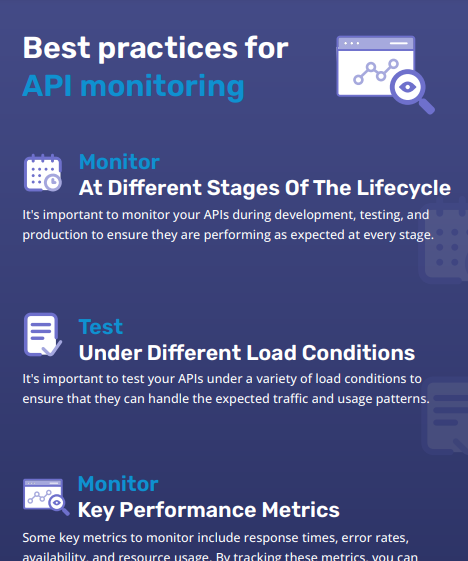
Effective API monitoring goes beyond checking whether an endpoint returns a 200. This infographic summarises the key practices that separate teams with real API visibility from those flying blind.
View resource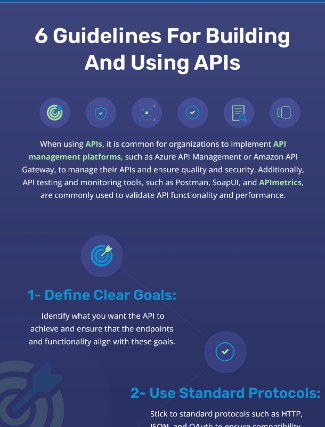
Good API design and usage practices compound over time. This infographic distils six core guidelines that help teams build APIs that are reliable, discoverable, and easy to consume.
View resource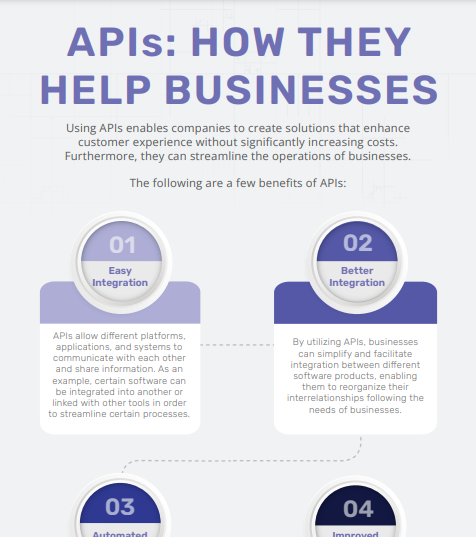
APIs are the connective tissue of modern business operations — enabling integrations, powering digital experiences, and opening up new revenue channels. This infographic explains the business value of APIs in concrete, accessible terms.
View resource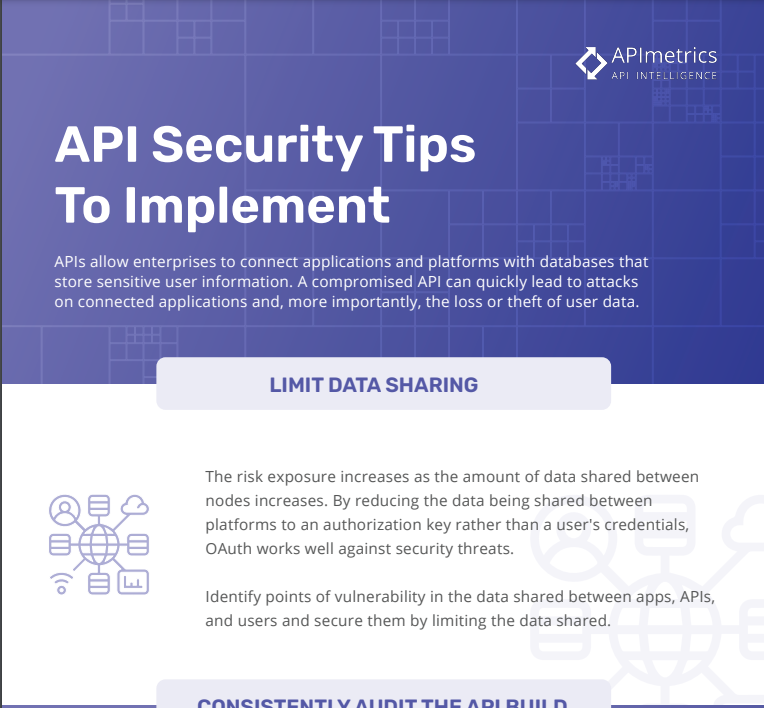
API security covers a wide range of concerns — from authentication and authorisation to rate limiting, input validation, and monitoring for anomalous behaviour. This infographic highlights the most impactful security practices for teams managing production APIs.
View resource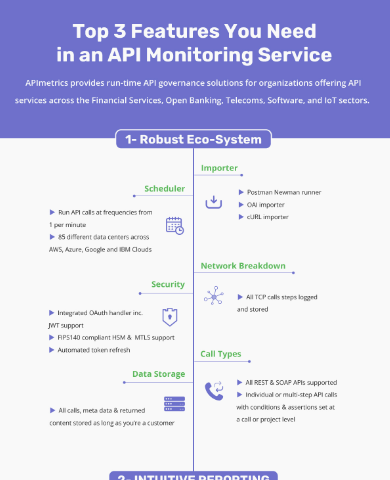
Choosing an API monitoring service means evaluating a lot of options with overlapping feature sets. This infographic cuts through the noise to identify the three capabilities that have the most impact on API reliability and observability in practice.
View resource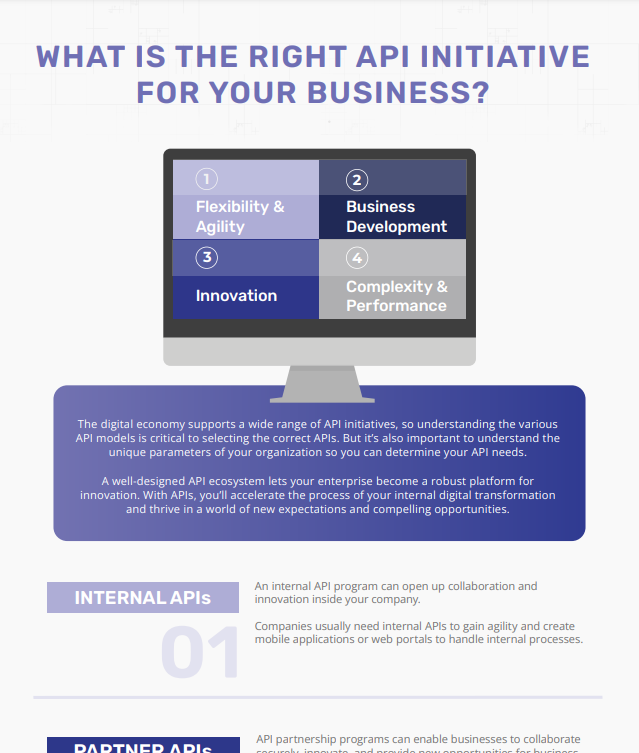
REST, GraphQL, gRPC, event-driven, and webhook-based APIs each have different strengths. Choosing the right style for a given use case is one of the most consequential early decisions in API design.
View resource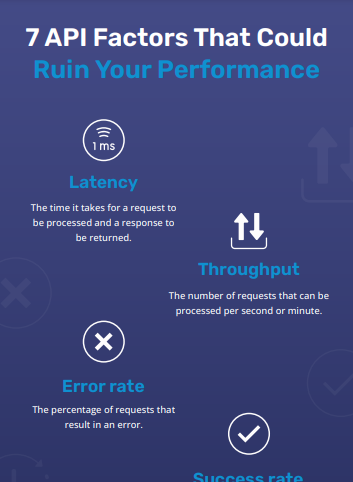
API performance problems rarely come from a single cause. This infographic identifies seven recurring factors that degrade API performance in production — from inefficient authentication flows to third-party dependency latency and poor caching strategy.
View resource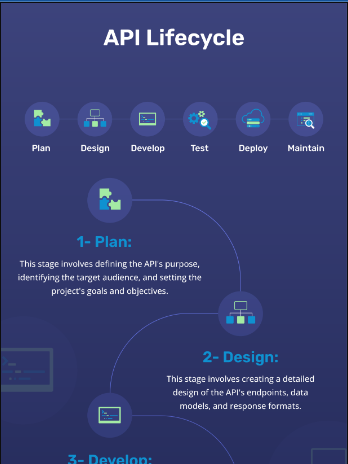
Managing APIs well requires understanding the full lifecycle: from initial design through development, testing, deployment, versioning, and eventual retirement. Each stage has distinct quality and governance requirements.
View resource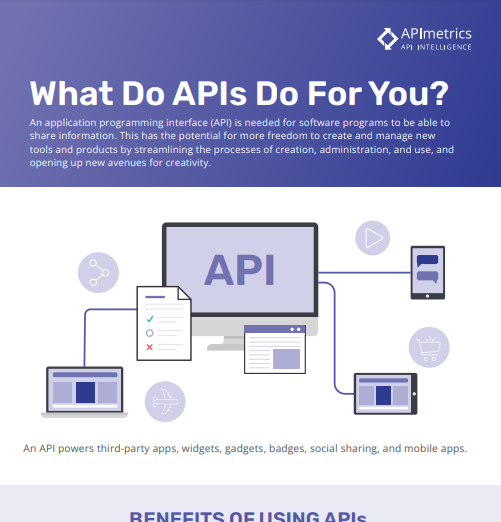
APIs are behind most of the digital interactions that businesses and consumers take for granted — from payments to notifications, data synchronisation to third-party integrations. This infographic explains what APIs actually do across a modern digital stack.
View resource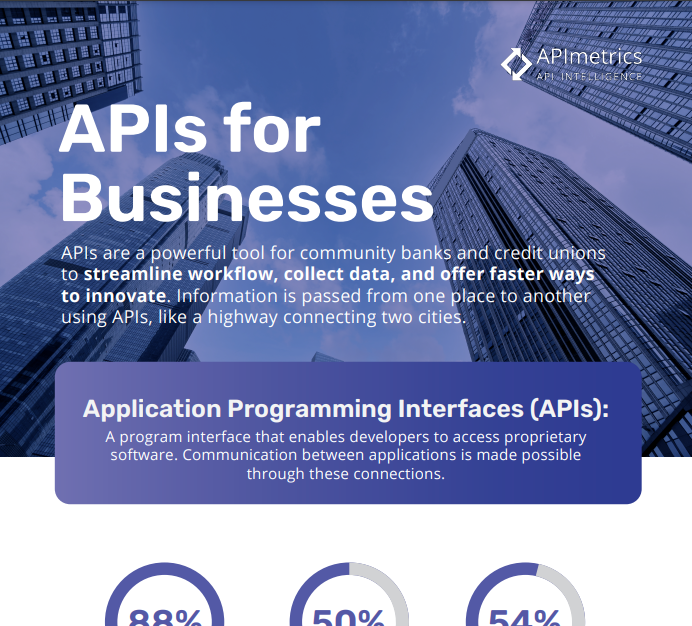
APIs drive business value in tangible ways: faster integrations, new product capabilities, partner ecosystem enablement, and more efficient operations. This infographic maps the business case for APIs across different organisational contexts.
View resource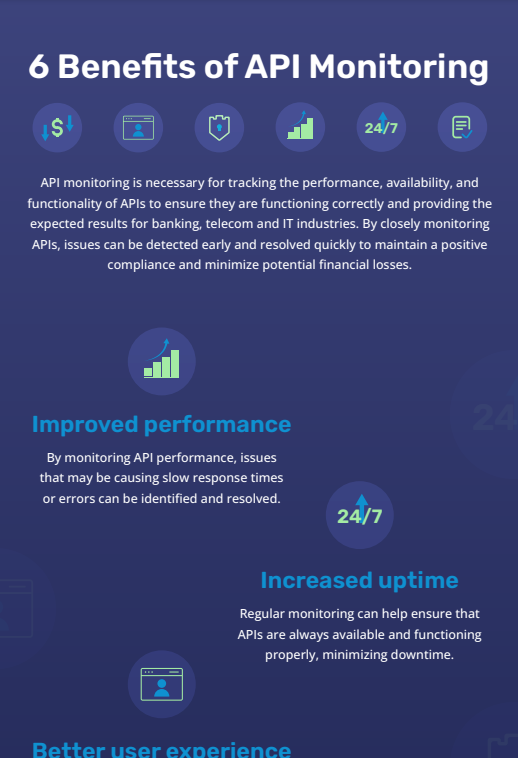
Teams that invest in active API monitoring consistently see benefits beyond basic uptime awareness — including faster incident response, better SLA evidence, improved consumer experience, and stronger governance.
View resource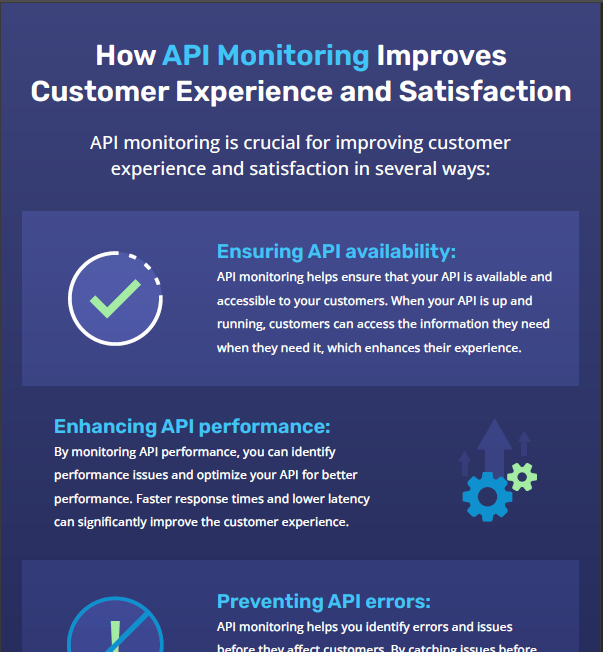
Customer experience is increasingly mediated by APIs — every transaction, notification, and integration depends on APIs performing reliably. When APIs are slow or unreliable, customers feel it directly, even if they never see the underlying technology.
View resource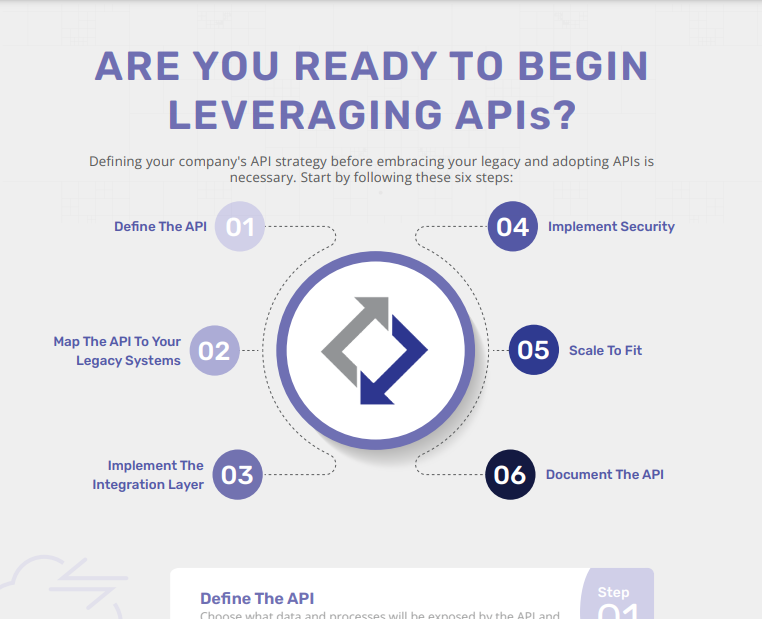
API adoption readiness involves more than technical capability. Organisational readiness — governance structures, security posture, monitoring practices, and partner integration strategy — determines whether an API programme delivers lasting value or creates long-term technical debt.
View resource