

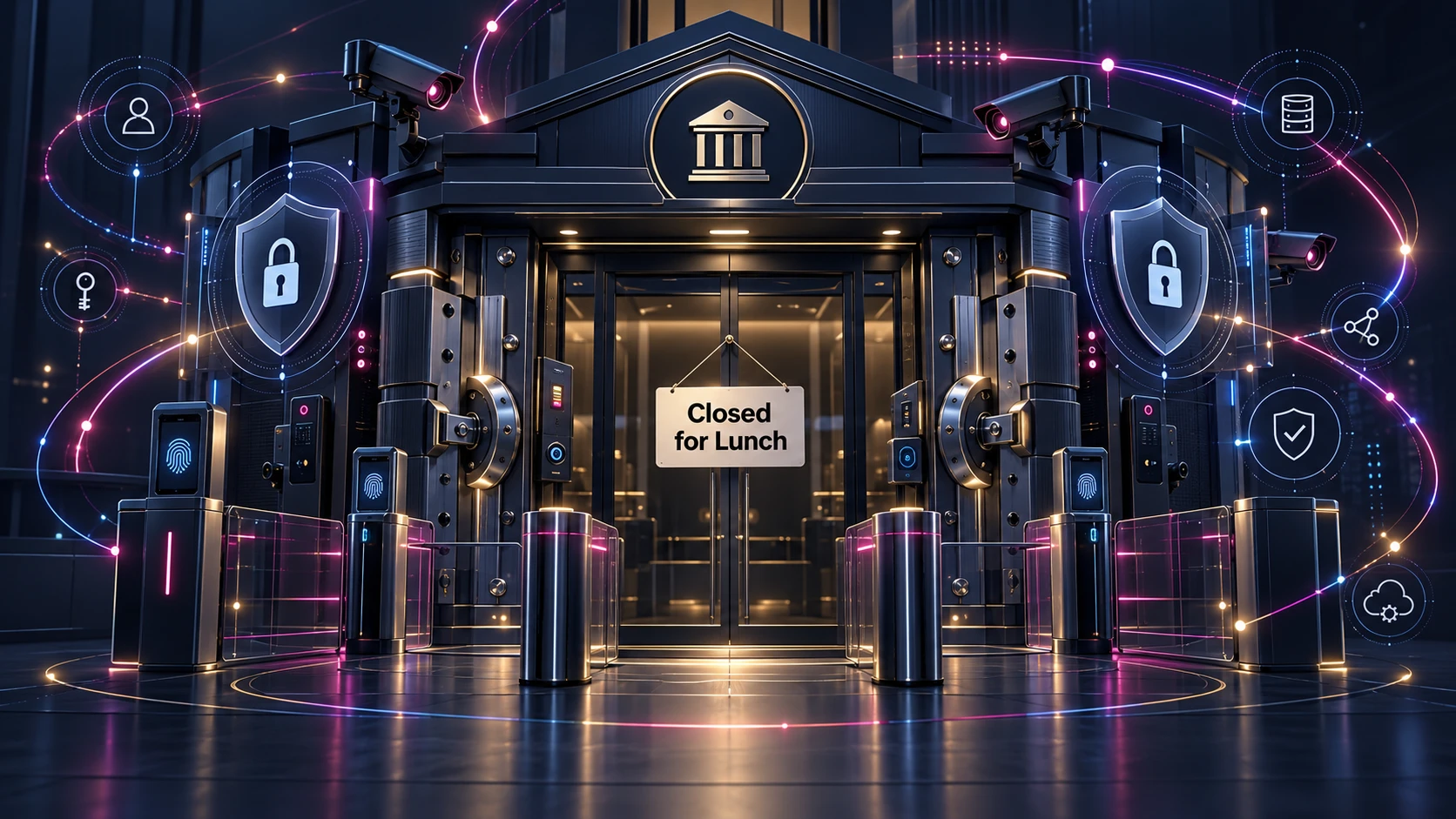

A guarded door doesn't mean the business is open
Imagine a bank branch with flawless security. The alarm is armed, the vault is locked, every employee badge is validated, and cameras cover every entrance. Nobody gets into a room they shouldn't.
There is just one problem: customers can't withdraw any money.
Nobody would describe that bank as operational simply because it was secure. Yet we routinely make something close to that mistake with APIs. Enterprises have invested heavily in discovering APIs, cataloguing them, controlling access, identifying vulnerabilities and detecting abuse. That work is essential, and runtime API security exists for good reason.
But security answers a particular set of questions: Is this API known? Is access controlled? Is something malicious happening? Those are not the same as asking whether an authorized customer can actually use the API, right now, and get the right result.
An API can be fully discovered and correctly protected while still being useless to the person trying to use it. It can return 200 OK with the wrong data. OAuth can fail even though the API itself is healthy. A certificate can expire. A dependency three hops downstream can quietly break a transaction. Frankfurt can work while Singapore times out. Every component dashboard can be green while the customer's transaction is red.
Protection is one property of a working service. It is not evidence that the service works.
Security keeps the wrong things from happening. Somebody still has to prove the right thing can happen.
There is a useful way to think about the layers enterprises already have. API security asks whether something bad can happen: can an attacker get in, is sensitive data exposed, is an API misconfigured or being abused? Observability asks what is happening inside the system: what are our services, traces, logs and infrastructure telling us?
Outside-in verification asks a different question. Can a legitimate user authenticate, execute the transaction and get the expected result, with acceptable performance, from the places where the service is consumed? All three layers matter, but only the last one starts with the customer's experience rather than the system's internal state.
That distinction matters because customers don't consume architectures. They consume outcomes. They don't care that your identity provider is healthy, your gateway is healthy, your API is healthy and your downstream provider is healthy. They care whether the payment went through, the account was created, the prescription was submitted or the shipment was booked.
The architecture is made of components. Reliability is experienced as a journey.
Every security control is also a reliability dependency
This becomes especially important as APIs get more secure. Authentication, authorization, token exchange, certificate validation and identity services are security controls, but once they sit in the transaction path, they are also things that can break the transaction.
That creates a subtle blind spot. The API may be up while access to the API is down. The endpoint may respond while an OAuth flow fails one step earlier. A mutual-TLS configuration can be perfectly secure and completely unusable because a certificate has expired. A third-party identity provider can become the weakest link in an otherwise healthy application.
Every security control in the request path is also a reliability dependency.
That doesn't make the control undesirable. It means operational resilience has to test through it. A health check that bypasses authentication can tell you that a server is alive, but it cannot tell you whether a real client can successfully use the service.
And 200 OK does not mean the business worked
There is another common trap: confusing protocol success with business success. Suppose an account API responds in 80 milliseconds with:
{
  "accounts": []
}
That's a technically successful request. If the customer has six accounts, it's also completely wrong.
The same problem appears everywhere. A pricing API can return yesterday's price. A booking workflow can successfully create a reservation that never reaches the fulfillment system. A payment API can accept the first step of a transaction while a later dependency prevents completion.
HTTP status is not business status.
The useful question is not simply whether the endpoint responded. It is whether the real transaction produced the outcome we expected. That requires actually exercising the transaction and evaluating its result.
DORA makes the distinction unusually explicit
For financial entities in the EU, this is more than an observability philosophy. The Digital Operational Resilience Act, which has applied since 17 January 2025, repeatedly separates the ability to protect systems from the ability to keep them functioning.
Article 9 requires financial entities to continuously monitor and control the “security and functioning” of ICT systems and tools. Those words matter because they do not treat security as a proxy for functioning; they treat them as separate concerns.
DORA's testing requirements reinforce the distinction. Article 24 requires a comprehensive digital operational resilience testing programme for covered entities, while Article 25 explicitly includes both performance testing and end-to-end testing among the appropriate testing methods. Article 28 also makes clear that outsourcing a technology dependency does not outsource the obligation: financial entities using third-party ICT services remain responsible for compliance with DORA.
None of this means that deploying a monitoring product makes an organisation DORA-compliant. It doesn't. But it does point toward the kind of evidence resilience teams increasingly need. A security platform can show what was discovered, protected or attacked. An internal observability platform can explain what your systems were doing. Neither independently tells you whether a real, authenticated transaction worked correctly from outside your environment.
For that, you need evidence of functioning.
What evidence of functioning looks like
The principle is straightforward: exercise the real thing, use the real path, check the result, and repeat.
For an API, that means starting where the consumer starts. Authenticate using the same mechanisms a real client uses, including OAuth, JWT or mTLS, rather than testing an unauthenticated /health endpoint. Execute the full sequence when the business outcome requires multiple calls, because a transaction is only as healthy as the step that fails.
It also means checking more than the status code. Validate payloads, schemas and business rules that establish whether the result is actually correct. Run those checks from the places where customers and partners connect, because a global service that works beautifully from your cloud region and poorly from the customer's network is not globally healthy.
Finally, preserve the evidence: what happened, where it happened, how long each step took and which expectation passed or failed.
That is the model behind APIContext API monitoring and multi-step workflows. Checks can run from more than 125 nodes, as frequently as every 60 seconds. For internal and east-west services, private nodes bring the same verification model behind the firewall. Results can flow into existing observability platforms over OpenTelemetry rather than becoming another isolated telemetry silo.
The objective is not more dashboards. It is a different kind of evidence.
Your API inventory is a test plan waiting to happen
There is good news for organisations that have already invested in API security: much of the hard discovery work may already be done. You probably don't need another exercise to find every API. You need to ask a different question about the inventory you already have: which of these APIs represent transactions we cannot afford to have silently fail?
Not every endpoint deserves a synthetic test every minute. Start with the critical journeys: the payment flow, the identity exchange, the account-data request, the partner integration, or the internal API that twenty other services depend on.
Then verify those journeys continuously for availability, authentication, performance and expected business outcome. Add locations, dependencies and assertions where the risk justifies them. Over time, the API inventory stops being only a list of things that need protecting and becomes a map of things that need assuring.
Protected is not the same as operational
API security answers an indispensable question: can we prevent the wrong thing from happening? Operational resilience adds another: can we show that the right thing is happening?
A bank can have an impenetrable vault and a broken payments system. An airline can screen every passenger perfectly and still cancel every flight. An API can be completely secure and completely unusable.
The goal isn't to choose between security, observability and outside-in verification. Mature resilience requires all three, because the ultimate test of a digital service isn't whether every dashboard is green.
It's whether the customer can do the thing they came to do.
For regulated financial services, our banking solutions page explains how APIContext approaches continuous assurance for banks and other regulated teams. For more on the gap between healthy internal dashboards and real-world service experience, read Operational Resilience in Practice: Interpreting External Signals During Digital Disruption.