

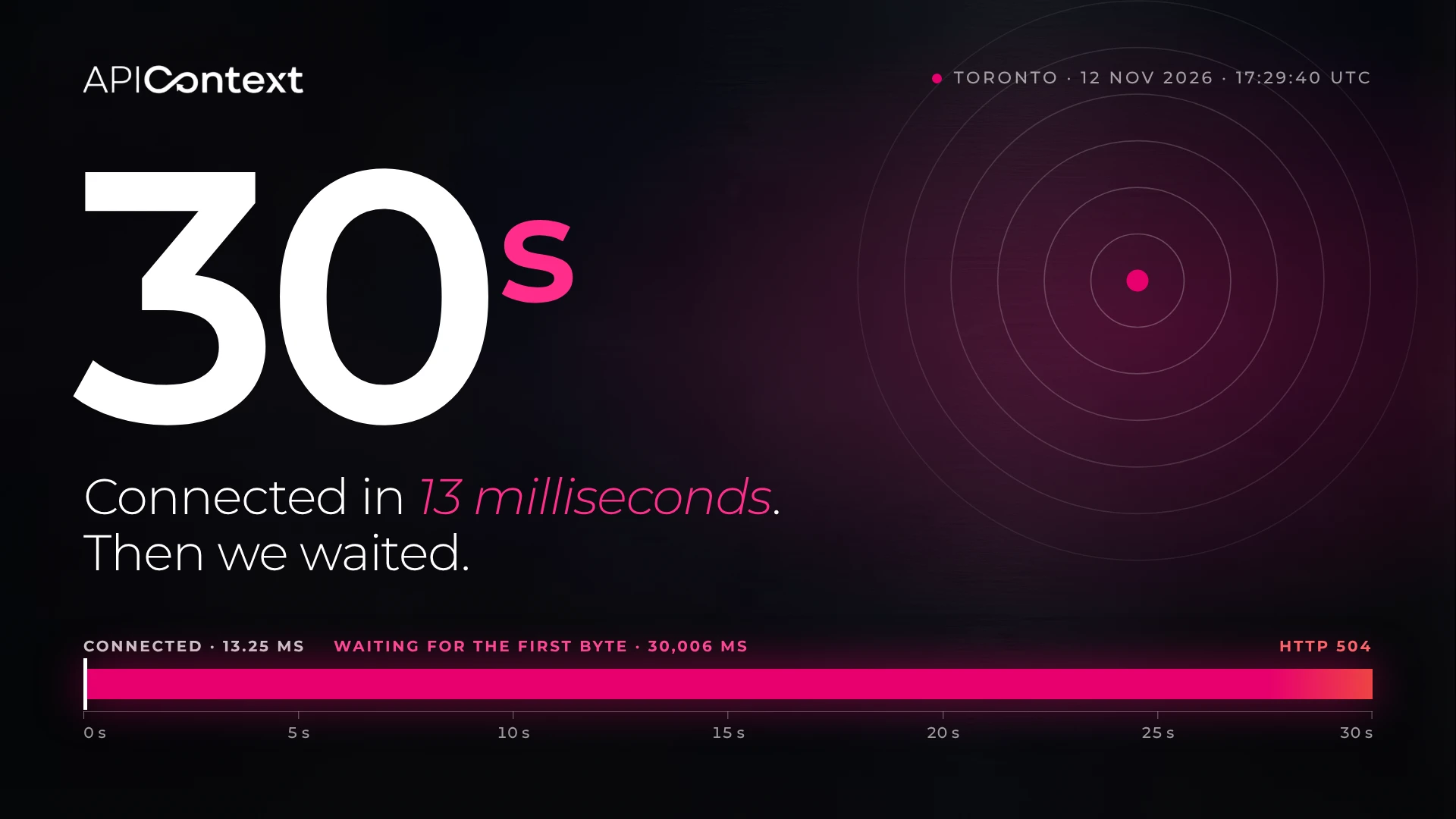

If I’d been on the incident call during the Microsoft 365 outage, I’d have wanted someone to put one request on the screen. At 17:29 UTC on 12 November, our monitoring agent in Toronto asked Microsoft Graph for a list of mail folders. It took about 13 milliseconds to look up the address, connect and establish a secure session. Then we waited thirty seconds. What eventually came back was a gateway timeout. Where had those thirty seconds gone?
Microsoft had already picked up a connectivity problem at 16:03, well before that Toronto check. Its final post-incident report explains how a defect on its networking gateways surfaced when Teams traffic moved onto the gateway shared with Exchange, some capacity was unavailable and peak demand arrived. As machines stopped responding, their work moved to machines that were still available. That made the remaining gateways more likely to encounter the same defect.
What interests me is the decision that follows. Say you’re the engineer about to move another group of customers onto a gateway. You know it accepts connections. How do you know it can complete the work you’re about to send it?

Source: APIContext. Exchange-backed Graph checks, 12–13 November 2026 (UTC). The final hour ends at 07:55 UTC.
What a successful connection tells you
The internet is our network. It’s how the service reaches a customer, and parts of that journey belong to different teams. The network engineer can tell me that a connection opened. The application engineer can tell me that a mailbox read failed. Put those observations on the same request and we can start looking for where time actually went.
In Toronto, DNS took less than a millisecond, TCP took about two and the TLS handshake took about eleven. Once we’d sent the request, almost the entire wait was for the first byte to come back. That still leaves several possibilities. A gateway might be waiting for another connection, retrying work or waiting its turn in a queue. From outside we could identify the interval to investigate. Microsoft’s engineers had the access needed to explain what happened inside it.
Later, we found a pattern I’d have taken straight to the gateway team. In 37 of the 43 HTTP 502 responses we retained, the wait after upload was between 21.0 and 21.1 seconds. We saw it on calendars, contacts, messages and mail folders, from probes on six continents. These were selected traces collected while investigating failures, so they tell us little about how often an arbitrary customer would hit the problem. What they give an engineer is a precise question to ask of the logs: which downstream operation was still outstanding when those 21 seconds expired?
Could someone still get their work done?
At 10:00 UTC on Friday, 13 November, the picture depended on which question we asked of Microsoft Graph. These are results for seven selected monitors during the hour beginning at 10:00. Each check attempted one authenticated operation.
| Graph operation | Failed checks | Total checks |
|---|---|---|
| Calendar | 4 | 4 |
| Contacts | 4 | 4 |
| Messages | 4 | 4 |
| Mail folders | 3 | 3 |
| Profile | 0 | 4 |
| Drive metadata | 0 | 5 |
| List drive items | 0 | 4 |
Source: APIContext. Selected Microsoft Graph monitors, 13 November 2026, 10:00–10:59 UTC.
If you’d checked whether someone could open a file, you’d have had a perfectly accurate answer to the wrong question for the person trying to read their mail. For an SRE, the successful reads are useful evidence. They give you requests that worked through the same public service name, during the same hour, to compare with requests that failed.
When is it safe to send more traffic?
Microsoft’s report says that at 17:32 on Thursday, traffic redirection was continuing and conditions were worsening across regions. By then our Toronto check had returned its timeout. Had that record been available alongside the routing data, I’d have asked the team to identify the pool that received it. The city where our probe ran tells us where the request started. It takes a correlation ID or a controlled routing test to establish where Microsoft sent it.
This is where I see a role for an SRE using an AI agent. Give it read-only access to the external results through the Model Context Protocol (MCP), alongside the internal records it’s authorised to query. Ask it to find mailbox reads before and after a traffic shift, match them to the receiving pool, and bring back completion rates, queue ages and sample counts. If that pool accepted more connections, completed fewer reads and accumulated a longer queue, the team would have a reason to pause before expanding the shift. Whether pausing was safe would depend on spare capacity and the options available to the people running the service.

Source: APIContext. Last observed failure by probe geography, 13 November 2026 (GMT).
The last mailbox read in Frankfurt
Recovery is where I find this particularly tangible. Microsoft reported that European availability had returned to healthy levels at 11:35 UTC on Friday. At 13:33, our Frankfurt probe asked for contacts. The connection opened, TLS completed, and the request waited 21.028 seconds after upload before returning a 502. The same pattern was still visible on an individual transaction nearly two hours after that regional milestone.
Across our network, the gap between the earliest and latest final failures we recorded by continent was almost one hour and 48 minutes. Those are the times our scheduled checks saw errors. They tell us where to look for a lingering problem. They can’t tell a business whether a particular email that was queued overnight has reached its recipient.
For me, that’s the blind spot worth addressing. When a critical supplier has an incident, I want the team making the next routing decision to be able to follow a customer’s request from the connection opening to the work completing. External monitoring could have given that team specific requests to trace and a repeatable delay to explain. Whether it would have reduced the blast radius is an open question. We have enough evidence to say which decision it could have informed, and what else the engineers would have needed to make it.